
Every decision we’ve made at Wirrigirri feels like putting another piece into the jigsaw of who we are and what our school stands for. Each one shapes the kind of school we’re becoming, a place that reflects its landscape, honours connection to Country, and sees learning as something that happens everywhere, not just inside the four walls of a classroom.
From the beginning, our grounds were designed to feel like an extension of the natural environment around Wollert. The architects worked in consultation with local Wurundjeri Elders and cultural representatives throughout the design phase, ensuring that the land’s story, materials and features were respected and reflected in every choice. The curves of the buildings follow the contours of Country, and the outdoor spaces draw inspiration from local flora, fauna and waterways.
The landscape itself was designed to be experienced. Timber, rock and natural elements create spaces that invite exploration and movement. The swale that runs through the centre of the school is one of my favourite features. When it is dry, it blends quietly into the background, but when it rains, it fills, ripples and transforms. It becomes a living classroom and a place for muddy puddles, reflection and discovery. The kind of learning that can’t be scripted, only experienced.
So when we talk about all-weather play, it doesn’t feel like a new initiative. It feels like a continuation of the very principles Wirrigirri was built on. Instead of seeing Melbourne’s unpredictable weather as a challenge, we’ve learned to embrace it as part of who we are.
Across the world, outdoor learning is deeply embedded in education systems. In Finland, Scotland, Canada and throughout the Nordic countries, children play and learn outside in all seasons, building resilience, curiosity and wellbeing. Yet in Australia, the pattern has shifted in the opposite direction. Research from the Australian Institute of Family Studies (2024) shows that children are spending more time indoors than ever before, a consequence of increased screen use, structured routines and a growing discomfort with ‘bad weather’.
The NSW Government’s Good for Kids – Healthy Life (2023) initiative highlights that children are almost twice as active outdoors as they are indoors, highlighting the importance of outdoor environments for movement, wellbeing and development. Similarly, a 2023 literature review by Nature Play WA found that outdoor learning supports stronger attention spans, collaboration, and creative thinking, while fostering a sense of belonging and environmental responsibility. The message is consistent across all of this research…children need time outside, in all weather, to thrive physically, socially and emotionally.
The evidence is clear: outdoor play strengthens motor development, concentration and social connection (Fjørtoft, 2001), and time in nature enhances attention, emotional regulation and wellbeing (Mårtensson et al., 2014). It also builds self-regulation and problem-solving, capabilities that underpin lifelong learning and are so important to whole-child development.

At Wirrigirri, those findings come to life every day. We see children collaborate, negotiate and lead through play. They climb, dig, splash and create. Some teachers love being out there with them, while others quietly prefer clear skies…but all of us agree it’s the right thing to do for children. That shared understanding is what makes this part of our culture.
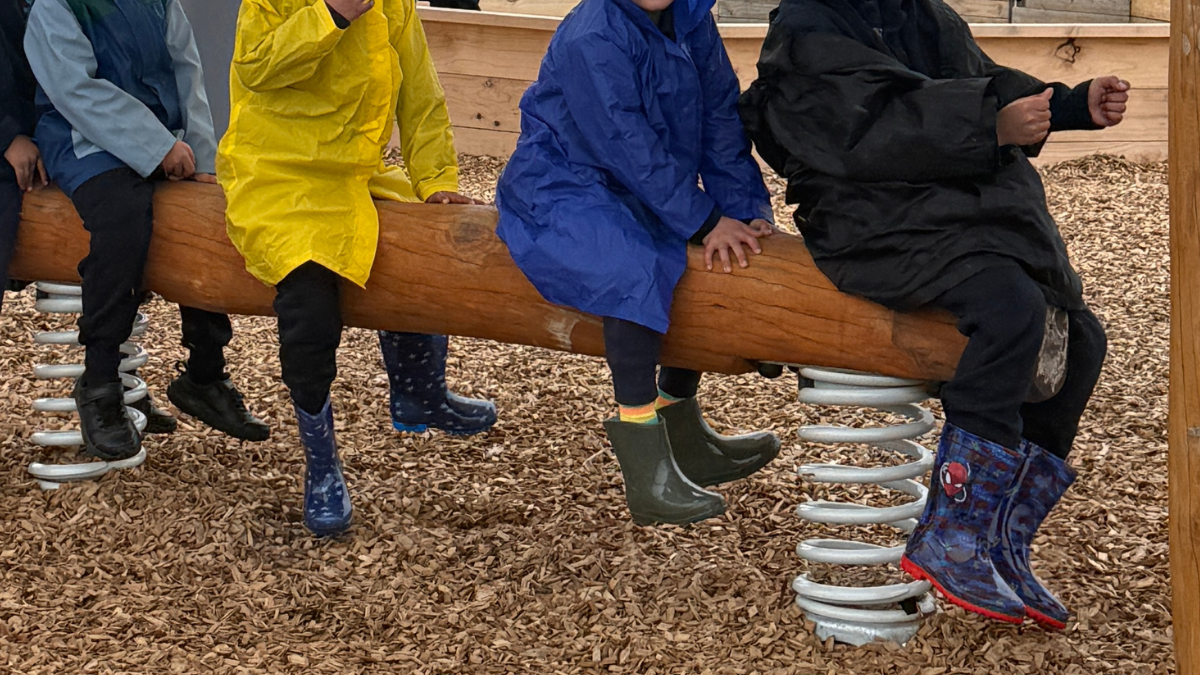
It’s also reflected in how we prepare for it. From before the school even opened, we spoke to families about our all-weather approach. Our dress code includes gumboots and a raincoat as essentials so every child can participate comfortably, regardless of the forecast. We don’t have a prescribed wet-weather uniform, and we celebrate the individuality that appears on rainy days, the bright gumboots and raincoats! Comfort over conformity; readiness over rules.
Over time, this way of thinking has simply become part of the Wirrigirri way. Rain doesn’t cancel play, it changes it. The landscape, the weather and our philosophy all work together to create an environment where children learn through experience, connect deeply to place and find joy in the unpredictable. Leading a school like Wirrigirri means embracing that same mindset, having the courage to step into the unknown, both metaphorically and literally, and trusting that something meaningful will emerge. Cultural change doesn’t happen through plans alone; it grows from consistent, values-driven choices. Each time a teacher zips up a raincoat and heads outside, they model the kind of leadership we want our children to learn: flexible, grounded and brave enough to get a little muddy in pursuit of something worthwhile.
~ Bec
If you enjoyed this piece, you might also like Learning Begins in Play, which explores how play forms the foundation for curiosity, creativity and connection in the early years.
References
Australian Institute of Family Studies. (2024). Why are children spending more time indoors? Australian Government. https://aifs.gov.au/resources/policy-and-practice-papers/why-are-children-spending-more-time-indoors
Fjørtoft, I. (2001). The natural environment as a playground: Outdoor play in a natural environment improves motor fitness in children. Early Childhood Education Journal, 29(2), 111–117. https://doi.org/10.1023/A:1012576913074
Mårtensson, F., Boldemann, C., Söderström, M., Blennow, M., Englund, J-E., & Grahn, P. (2014). Outdoor environmental assessment of attention-promoting settings for preschool children. Health & Place, 28, 34–42. https://doi.org/10.1016/j.healthplace.2014.03.016
Nature Play WA. (2023). Outdoor learning, outdoor play and the school environment: Literature review. https://www.natureplaywa.org.au/research-reports/outdoor-learning-outdoor-play-and-the-school-environment-literature-review/
NSW Government. (2023). Benefits of outdoor play for children. Good for Kids – Healthy Life. https://goodforkids.nsw.gov.au/media/3434/1-benefits-of-outdoor-play-fact-sheet.pdf